Showing posts with label Linework. Show all posts

Saturday, February 24, 2007

Reminiscing


I was cleaning up my house in the mountains this weekend. I found an old, disposable camera that I had forgotten to develop. It had a bunch of pictures from the last winter that I worked in the Oakhurst and Yosemite areas. I find myself missing being cold, wet, and tired. The payoff of getting everyone's power back on was a great incentive. It just makes you feel good. Here's a few pictures from last year's winter linework.

Thursday, February 01, 2007

Eagles, California Condors, and Ospreys

My current position leads me to some interesting places around the Kern service area. I was tasked this week, to patrol some of our lines that have had issues with the local wildlife - namely, killing them. My first stop was a place called the Kern Water Bank. Basically, there are a few thousand acres on the west side of the valley that they flood with water. The water seeps down to the water table, and PRESTO , we have water for the future. In the meantime there are huge ponds of water. Lots of water brings lots of birds. Lots of birds run into the powerlines. Now it is my job to figure out ways to reconfigure the setup on the pole so as to discourage the birds from electrocuting themselves. It's fun.

Today I spent the day at the Bitter Creek National Wildlife Refuge, in-between Maricopa and Cuyama, California. This NWR is home to the California Condor - last of its kind. It was a beautiful day. The sun was out and the sky was blue. It made me a little homesick for Oakhurst.

One of the nice things about working in areas that have raptor protection issues is that they have a lot of raptors to look at. I saw a lot of Eagles and Hawks today. I even saw an Osprey.


OK. So it wasn't a Pandion haliaetus, but rather a V-22. At any rate, it was really cool to watch.

Monday, January 08, 2007

What A Lineman Wants For His Birthday

There are a number of places to find the tools of the lineman's trade. Here are a few of my favorite places to spend that hard-earned double-time pay.


Highline carries just about everything that a Line Crew could need.


Far West carries what a lineman wants. They're also fast at shipping.


Lineman Barn is the place to get Lineman themed gear. Shirts, hats, and gifts for the whole family.


Hall's Safety is an East Coast based company. A buddy of mine swears by their boots. 50 years and running. They must be doing something right.

I absolutely LOVE wearing my Hoffman Danner Trooper Lineman Boots. They are as comfortable as slippers, from day one. Yet, they are as tough as nails in any situation. They're waterproof to boot. Some guys love Wesco boots, but I'll never be able to go back.


While you're here, check out some of my other "Favorite Things"

Saturday, January 06, 2007

Northwest Lineman College

Linemen end up in the trade by many means. For many, it is a family tradition; the hooks are passed down from generation to generation. Some are as lucky as me, and walk off the street into one of the best jobs in the world. For a few more, it is the result of hard work and planning. Many lineworkers choose to go to school, before they ever get hired as an apprentice.

Northwest Lineman College is a fine example of just such a place. NLC was created by a former employee of Pacific Gas and Electric. Gerald McKie recognized a need within the industry for employee candidates with prior experience. NLC was created for that purpose. The NLC boasts an 85-95% placement rate within the industry after graduation from the program.

I have several friends from work who went through the program at NLC. We went through the apprenticeship program our utility employer provides. I can say that their previous education at Northwest Lineman College gave them a competitive edge. Whereas I was sweating it every time I learned something new, they were hearing it for the second time. Experience counts for everything in this trade. If you are thinking about entering the field of Linework, I would strongly recommend that you consider NLC.

Friday, January 05, 2007

C'mon, Goob


Do you want some Power Lineman videos? It seems as though some of you have been looking for them. Here are a few of my favorites.

C'mon Goob - This is the infamous "pole top drop" that many of you may have seen. The poor guy got ahead of himself, and the rescue dummy pulled him right out of the wood.

Load Break - A massive arc goes out when the transmission switch opens.

It Go Boom - You can never be too careful.

Go here for a greater selection of high voltage video. The folks at Teslamania are my kind of people. Powerlineman.com also has some great video of the high voltage variety. I'll be honest; I don't have any video of my own - yet. All the videos I've posted here are available at either one of the two sites I listed above. Enjoy.

For those of you who walk the wood, wire, and steel - C'mon Goob!


Go to LINE-MAN.COM for the 2009 Calendar

Tuesday, October 24, 2006

Power Lineman Series: A/C Power and Tesla


Let me begin by quoting Mark Twain - a close friend of my electrical hero, Nikola Tesla.

Thunder is good, thunder is impressive; but it is lightning that does the work. August 28, 1908

Mr. Twain knew this from close and personal experience. He had the most fortunate opportunity to have befriended the lone genius known as Nikola Tesla. Twain was often found hanging about Tesla's laboratory, playing with whatever new discovery had been borne into existence.

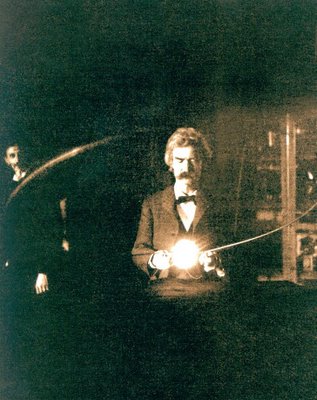
Tesla's name may be most synonymous with the coil that carries his name. The Tesla Coil is a resonant electrical circuit in which the primary voltage and the secondary voltage resonate at the same frequency. Through the use of many electrical apparatus (which I do not yet understand) this ungrounded contraption essentially creates lightning. In the picture above, Tesla sits in his Colorado Springs laboratory while one of his coils creates bolts of electricity on the order of MILLIONS of volts. That's right. Millions. The noise created by the coil on his mountaintop lab could be heard 10 miles away. Check out this link to see a much smaller Tesla Coil in action.

Tesla is my hero for having developed, and promoted the use of Alternating Current. Good old A/C. For those of you who just thought, "A/C? Like AC/DC? Isn't that a band? I thought AC was air conditioning. I like air conditioning. Why does it cost so much to run it? Back in Black totally rocks as an album," all I can say is that you think too much, too fast. Alternating Current is what allows us to live hundreds of miles from where electricity is generated. You can thank Mr. Tesla and Mr. Westinghouse for their commitment to the technology. They faced the bulldog known as Thomas Alva Edison; the proprietor of Direct Current, or DC, technology. Had Edison gotten his way, there would be a powerhouse and substation on nearly every corner. What a noisy and ugly way to bring power to the people. Tesla's A/C has the advantage of mobility. Due to it's nature it can cross multiple miles without losing power. Edison's D/C just doesn't have the capability to produce the kind of power needed for most of the world.

Most of my inspiration from this post comes from the book I'm reading now, Tesla: Man Out Of Time, by Margaret Cheney. Tesla is most certainly a man beyond his time. Truthfully, much of his work is still beyond our own time. Scientists today are still unable to reproduce some of his more playful inventions. He created the electron microscope and the cyclotron before anyone even had a word for these things. In essence, Tesla was the quintessential mad scientist: playing with voltage pressures in the millions - creating lightning, plasma, and wild machines.

Today, you can see a fictional representation of the professor in the latest turn-of-the-century magician rivalry movie - The Prestige. David Bowie creates a believable Tesla character in the movie. This is what sparked a renewed interest in Tesla's constructs, for me. If you're looking for an entertaining, slightly suspenseful, and partly historical account of fictional and factual characters; The Prestige is your movie. Electrifying!

Plugs aside, I owe a great debt of gratitude to Mr. Tesla. He created the industry which keeps me employed. For those of you looking into the electrical trade, I would suggest that you read about those who have come before us. Understanding the past gives us the ability to appreciate our present fortune.
Some more links to meander through:

Magnifying Transmitter

Plasma Lamp

War of Currents
Wednesday, October 18, 2006

Power Lineman Series: Apprentice Lineman


An Apprentice Lineman is a worker that aspires to become a Journey level Lineman. The path to becoming a Lineman is something that will take commitment, a measure of skill, determination, an ability to work at heights, and a generous portion of common sense. In essence, Linework is the construction and maintainence of both de-energized and energized powerlines. Overhead powerlines are usually wooden poles with suspended wires on them. The wires are under great tension to keep them high enough in the air to avoid accidents with the public. The tension on the lines, combined with the hazard of high voltage and height issues create a work environment that takes years to safely negotiate with confidence. First, you must start your apprenticeship.

In the high voltage electrical trade, becoming an Apprentice Lineman is the natural progression towards becoming a Journeyman Lineman. Generally, there are two ways to go about becoming a Lineman. You can start by working for either a Public Utility (as I do), or you can work for a contractor. There are benefits and drawback to both avenues. At most utilities, your training is done "on the job". Every day that you go to work, your journey level Lineman will train you in some new aspect of the trade. You also attend special schools, on company time, to hone some skills in a controlled environment. Apprenticing with a contractor usually means that you will be going to school, after work hours, for several hours a week. At a utility you can usually settle down and buy a home in the area that you work - knowing that you will continue to have a job in the local area. Contractors go where the work is available. This usually means that you will be on the road, or out of town for long stretches of time. For some, the predictability of the utility work is desirable - for others, the opportunity to be out "booming" is what they love. Contractors pay double-time for all overtime work. This too is a draw for some. In the end, the work is pretty much the same: wires, poles, heights, and electricity.


An Apprenticeship is a way for the unskilled to become skilled through a process of successive steps. Each six month long step is both a raise in pay, and a raise of the bar. An apprentice must master a new set of skills for every step he reaches. Where I work, an apprenticeship comes in two lengths. For those who have had experience as a Groundman, the apprenticeship is 36 months - six, six-month steps in all. For those hired off the street, the apprenticeship is 42 months long. Contractors' apprentices undergo a 48 month long apprenticeship.


The six steps of an apprenticeship are set forth by the Joint Apprenticeship Training Committee - or JATC. The JATC's job is to maintain the standards necessary to produce productive, and highly skilled workers. Although the specific layout of the coursework may vary, the general progression of training for apprentices is as follows:


  1. The first step of training usually focuses on learning how to climb a pole. Since a lineman has to climb up to be able to work, this is the first skill acquired. This first step also trains the apprentice in the basics of the electrical system. An apprentice will learn about the common tools and materials of his trade.

  2. The second step introduces an apprentice to working on energized secondary conductors. These are wires energized from 110 to 500 volts. Apprentices will also learn how to properly ground primary conductors, as they are not yet permitted to work on energized conductors over 1000 volts. Rigging and transformer basics are also taught at this stage.

  3. This third step introduces an apprentice to Live Line work. This is the use of hot stick tools to manipulate and repair energized powerlines while standing on a pole. The key to Live Line work is not brute force, but finesse. A strong understanding of rigging will make an apprentice lineman's job much easier at this stage.

  4. Step four introduces the apprentice to Rubber Glove Techniques. This is the work of moving, repairing, and replacing energized powerlines at a very personal level. A lineman wears special insulating gloves while standing on an insulated platform, and works the powerlines with his hands. Because of the danger of working in such close proximity to energized wires, extensive training is involved.

  5. Step five is a chance for the apprentice to learn advanced line techniques. These classes focus on the specialized tools and practices needed to work on special projects.

  6. The final step is dedicated to learning the skills needed to perform work on underground electrical systems. The apprentice will learn how to splice cable, test equipment, and perform safe work practices.

After three years of training, the apprentice undergoes one final cumulative test of his knowledge. Should he pass, he will be awarded with a certificate from the state which proclaims him to have attained Journeyman status. Now the real work begins.


Next time: What does a Lineman do anyway?

Sunday, October 15, 2006

Power Lineman Series: The Groundman


This is a post dedicated to those who have been directed to my site by various web search engines, looking for what it means to be an electrical lineman. For the most part, I'll draw from my personal experience. I'll also give you some links that I've found to be interesting.

Look to the bottom of this post, and others in the series, for the label. By clicking on the label "Linework" you will be able to read all the posts I have made concerning Linework and it's associated industries.


The next posts will be a series of sorts. I'd like to share what I've learned about what it takes to be a Lineman.


Often, the first step towards becoming a Lineman is to get a job as a Groundman or Utility Worker. This job is a good way for those unskilled in linework to develop the base skills needed to become a skilled Lineman. A Groundman's duties often include the following:


  • Driving a Class A vehicle such as a Digger/Derrick or Aerial Lift

  • Stocking the truck with material for the day's work

  • Operating a Digger/Derrick to dig holes, and set poles or equipment

  • Using a handline to deliver materials to a Lineman on a pole or in an aerial lift

  • Anything else your Lineman or Foreman tell you to do.

For the most part, you'll be learning the names of all the tools you use in the course of your work, as well as their specific uses. Believe me, there are a lot of tools to master. One of the more difficult aspects of the job is that Linework has its own vocabulary. Not only will you be learning work techniques; you'll be learning a new language. Tools and materials seem to have several sets of names. Some names are traditional; passed down from the earliest days of linework. Some names are endemic to the company you work for. Some names are very localized; more like nicknames. My advice is that you pay the most attention to whatever names your Lineman calls his tools and materials. After all, it's your job to make sure that your Lineman has the tool he needs before he has to call for it.


This is the ultimate job of a Groundman: make sure that your linemen always have what they need to complete the job at hand. My first lineman explained it to me this way; you need to be able to look up at the pole at what your lineman is doing and read his mind. Don't worry if you aren't able to anticipate you lineman's next move when you first start working as a Groundman. If your lineman is understanding, he will remember that he had a lot to learn when he started working the lines. But remember this: he will not likely give you any slack for something he has already told you. Linework is a serious business. A mistake made here can kill.


As a Groundman you will be entering a dangerous, but rewarding, field of work. Stay "cut in", and you'll make it to the next step: Apprentice Lineman.


For now, you can read up on what other people have to say about linework.


LINE-MAN.COM


Northwest Lineman College


International Brotherhood of Electrical Workers


Thursday, March 23, 2006

I know, all I do is talk about work.

Yeah. More work blog. I find that I don't get to talk about much else since I do little other than sleep and work. I'm hoping that with the arrival of more Springlike weather, the need for me to work 20 hour days will be less.

Yesterday I, yet again, worked late into the night. An underground transformer went bad, and required replacement. The difficult thing about working on underground equipment is that it is underground. Mostly, it means that you'll be doing a lot of kneeling, squatting, hanging upside down, and generally being uncomfortable. The great thing about this particular transformer replacement was that it had leaked out most of the insulating oil. This meant that we had to drain out the underground compartment, as it was a foot deep in oil, or about 50 gallons.

It is frustrating to finish an underground job if you are tired and just want to go home. Mostly because you can't really hurry at all to finish up earlier. Everything takes longer. Performing switching to work on the underground system takes a lot of time. The thousand little extra things you have to do to keep an underground electrical system watertight add up in time. We finished all our work by about 1am. Fortunately, PG&E doesn't make workers come in at their normal work hours if they work as late as that.

On a completely different note. I am totally excited about heading to the Central Coast this weekend. It will be a welcome change in pace. I'll finally get to spend some time with my wife, and really enjoy a full day. I'm thinking of splurging and getting a Deep Tissue Massage at our hotel. I'm so cramped and sore that I can hardly stand up straight. All I have to do is make it to tomorrow.